


How Much Storage Space Do I Need? A Size Guide for Aveley, South Ockendon and Thurrock
A 10ft container holds the contents of a one-bedroom flat, a 20ft container holds a three-bedroom house, and a 40ft container holds a full family home or a small commercial stock room. The right size depends on how many rooms you’re clearing, whether furniture is disassembled, and how long you’re storing for. Most people who guess end up one size too small.
What Size Storage Unit Do I Need? Quick Answer By Household
If you want the short version before the detail: a single room or a studio flat needs a 10ft container. A two or three bedroom house needs a 20ft container. A four bedroom house, a full house clearance, or a business with pallets of stock needs a 40ft container.
That quick answer gets most people to the right decision, but it breaks down fast once real life gets involved. A “three bedroom house” with a garage full of tools is a different job to a “three bedroom house” that’s been rented unfurnished for two years. The sections below go room by room and situation by situation so you’re not guessing.
Aveley Self Storage Container Sizes Explained
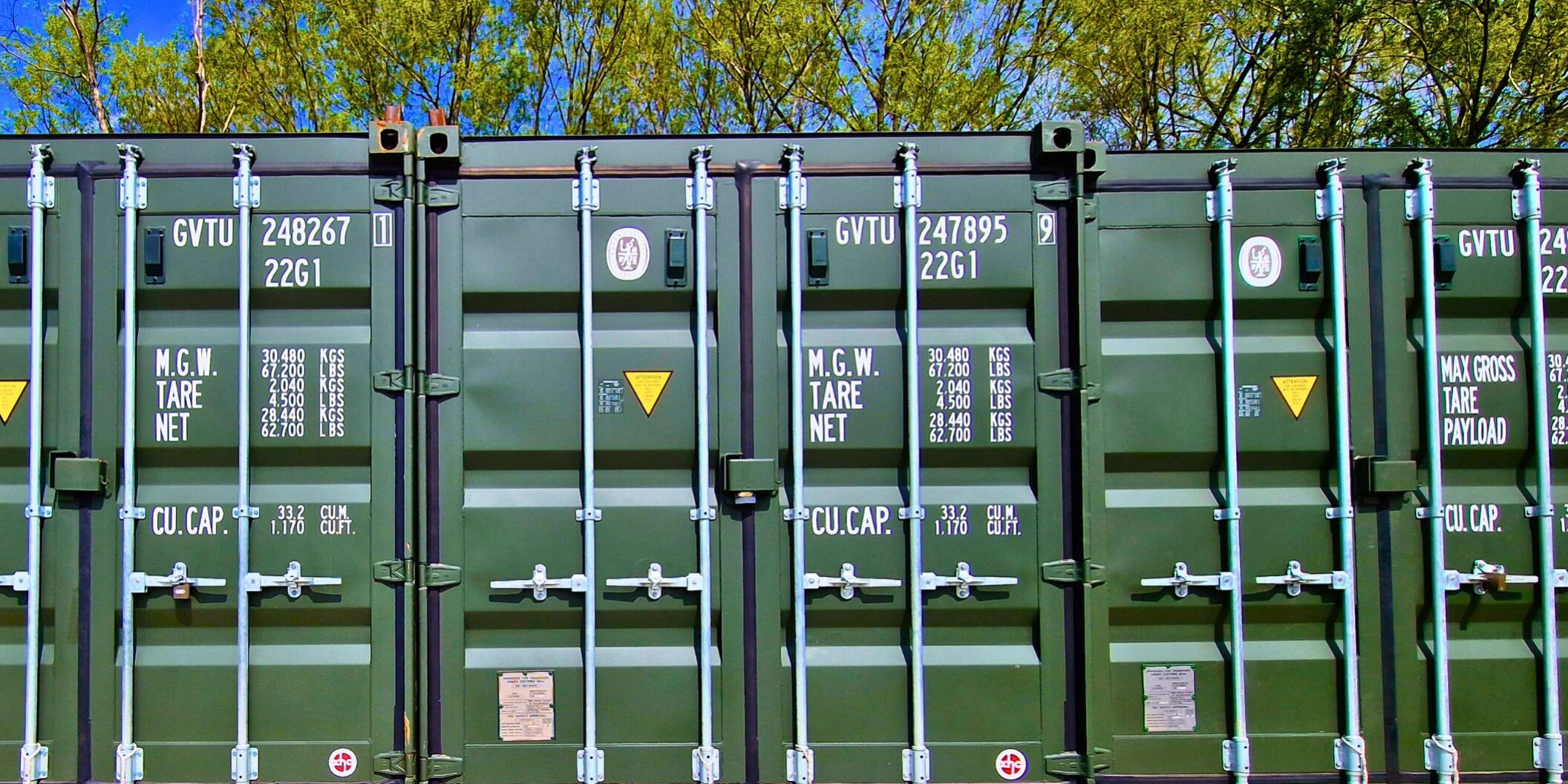
Aveley Self Storage runs three container sizes at our site on Romford Road, South Ockendon: 10ft, 20ft and 40ft. Every unit is a steel shipping container converted for storage, not a partitioned indoor room, which means the internal dimensions are fixed and the same figures apply whether you’re storing furniture, tools, or pallets.
| Size | Floor space | Dimensions (L x W x H) | Usable volume |
|---|---|---|---|
| 10ft | 75 sq ft | 10ft x 10ft 8in x 7ft 9in | Approx. 827 cu ft |
| 20ft | 150 sq ft | 20ft x 7ft 8in x 7ft 9in | Approx. 1,188 cu ft |
| 40ft | 300 sq ft | 40ft x 7ft 8in x 8ft 6in | Approx. 2,607 cu ft |
Those volume figures matter more than the floor space number on its own. A 10ft container is only three-quarters the footprint of a single garage, but because the walls run nearly 8ft high, you get almost as much usable space as the floor plan suggests once you start stacking boxes and furniture safely. Nobody quotes cubic footage on a storage website, so working it out yourself is the only way to know what you’re actually paying for.
How Much Fits in a 10ft Storage Container?
A 10ft container holds the contents of a studio flat or a one-bedroom flat comfortably, with room left over for a modest number of boxes. Think a double bed, a wardrobe, a sofa, a small dining set, a washing machine, and 20 to 30 packed moving boxes.
It’s also the size most people choose for a single-room clearout: a garage being emptied before a renovation, a loft conversion, or a spare room full of years of accumulated furniture and boxes. If your list of items fits on one sheet of paper, a 10ft is usually enough.
What typically fits in a 10ft unit:
- Double bed, mattress and one wardrobe
- A 2-seater sofa or armchair
- A washing machine or tumble dryer
- 20 to 30 standard moving boxes
- Bicycles, a lawnmower, garden furniture
How Much Fits in a 20ft Storage Container?
A 20ft container is the size most Aveley and South Ockendon households rent for a full house move. It holds the entire contents of a two to three bedroom home: beds, wardrobes, sofas, a dining table and chairs, white goods, and somewhere between 60 and 90 boxes depending on how well they’re packed.
This is the size that tends to surprise people. Because the container is long and narrow rather than square, it packs more efficiently than the same floor area in a square room would. Furniture goes in along the walls, boxes stack down the middle, and you’re left with an aisle to reach things at the back if you need to.
What typically fits in a 20ft unit:
- Furniture from 2 to 3 bedrooms, disassembled where possible
- A 3-seater sofa, armchairs, coffee table
- Dining table, 4 to 6 chairs
- Fridge freezer, washing machine, tumble dryer
- 60 to 90 boxes
How Much Fits in a 40ft Storage Container?
A 40ft container is exactly what it sounds like: two 20ft units end to end, giving you the space of three single garages. This is the size Thurrock households reach for during a full house clearance, a probate clearout, or a move where the new property isn’t ready and everything needs to sit in storage for a while.
It’s also the size we see businesses take for palletised stock, a van’s worth of tools and materials, or archive boxes going back years. If you’re not sure whether you need a 20ft or a 40ft, the honest answer is: measure what you have first, because upgrading later means a second delivery and, depending on availability, a wait.
What typically fits in a 40ft unit:
- Full contents of a 4+ bedroom house
- Multiple sofas, beds, wardrobes and white goods from every room
- A workshop’s worth of tools, ladders and materials
- Pallets of stock for e-commerce or trade businesses
- A motorbike or small trailer alongside furniture
Storage Size By Room: What Actually Takes Up Space
Most people underestimate how much a single room takes up once it’s boxed and disassembled. Use this as a rough planning guide, then add 10 to 15% on top so you’re not packing the unit floor to ceiling with no room to move.
| Room | Typical contents | Approx. space needed |
|---|---|---|
| Single bedroom | Bed, wardrobe, chest of drawers, boxes | 25 to 35 sq ft |
| Double bedroom | Double bed, two wardrobes, drawers, boxes | 40 to 50 sq ft |
| Living room | Sofa, armchairs, TV unit, coffee table, rugs | 40 to 60 sq ft |
| Kitchen | Fridge freezer, washing machine, boxed items | 25 to 40 sq ft |
| Garage or shed | Tools, bikes, garden equipment, ladders | 30 to 50 sq ft |
Add these up for the rooms you’re clearing and you’ll land close to a real figure rather than a guess. Two double bedrooms and a living room, for example, comes to roughly 120 to 160 sq ft, which puts most Aveley households squarely into a 20ft container.
Storage Size for a House Move in Aveley or South Ockendon
House moves in Thurrock rarely run to a single completion date. Chains fall through, new-build handovers slip, and it’s common to need somewhere for your belongings to sit for a few weeks between selling on Belhus Avenue or Purfleet Road and picking up keys on the new place. A 20ft container covers most three-bedroom moves; if you’re coming out of a four-bedroom house with a garage full of tools and a shed on top, go straight to a 40ft rather than booking a second unit later.
Because Aveley Self Storage has lorry access and a forklift on site, you’re not restricted to what fits in a car boot or a hired van on the day. Bulky furniture, white goods and heavy boxes can go straight from the removal lorry into the container without a second handling step.
Storage Size for a Home Renovation or Extension
Renovation storage is a different sizing problem to a house move, because you’re not clearing the whole property, just the rooms being worked on, and you need the unit for weeks or months rather than a single day. A kitchen extension in a South Ockendon semi typically displaces a kitchen’s worth of appliances and a living room’s worth of furniture pushed out of the way of dust and trades, which usually fits a 10ft to 20ft unit depending on how much gets moved out at once.
Loft conversions and full rewires tend to displace more, since everything from every affected room often needs to come out at the same time. If your renovation is going to run past six to eight weeks, it’s worth sizing up rather than packing tight, since a container you can still walk into to retrieve the odd item is far less hassle than one packed to the door on day one.
Storage Size for Decluttering vs a Full House Clearance
Decluttering and clearance are often lumped together, but they need very different unit sizes. A seasonal declutter, sorting out a loft or garage of things you’re not ready to throw away yet, is almost always a 10ft job: a handful of boxes, some furniture you’re not using, sports and camping gear.
A full house clearance, whether that’s downsizing, probate, or emptying a rental property between tenants, is a different scale entirely. Clearing an entire house means every room’s furniture, every appliance, and every box arrives at once, which typically needs a 20ft for a smaller property or a 40ft for anything larger. The mistake we see most often is booking decluttering-sized storage for a clearance-sized job and running out of room on moving day.
Storage Size for a Caravan, Motorbike or Trade Vehicle
Vehicles and trade equipment change the sizing maths because you’re working around a fixed shape rather than stackable boxes. A motorbike or a small trailer will usually share a 20ft container comfortably alongside other belongings. Larger items such as a caravan or a commercial van’s worth of stock and tools generally need the full 40ft, particularly if you also need walking space around the vehicle to load and unload safely.
If vehicle storage is your main need rather than an add-on to household storage, it’s worth looking at dedicated vehicle storage rather than sizing a general container around it, since parking and access requirements are different again.
Who a 10ft Unit Isn’t For
A 10ft container isn’t the right choice if you’re clearing more than one bedroom’s worth of furniture, moving from a two-bedroom property or larger, or storing a mix of furniture and a significant amount of trade stock or tools at the same time. We regularly get calls from people who’ve booked a 10ft for what they described as “not much stuff,” only to find on the day that a sofa, a bed, a wardrobe and thirty boxes genuinely fill it to the door with nothing left over. If your list runs to more than one room, size up before moving day, not after.
Who a 40ft Unit Isn’t For
A 40ft container is the wrong call if you’re storing the contents of a single room, a handful of boxes, or seasonal items you’ll want to access regularly. Paying for 300 sq ft to store what fits in a garden shed is the single most common way people overspend on storage. It’s also not the easiest option if you’ll need to get in and out of the unit frequently for small items, since a fuller 40ft takes longer to navigate than a compact 10ft you can see the back wall of at a glance.
Common Mistakes People Make When Choosing a Storage Unit Size
Underestimating boxed items.
A flat-packed wardrobe or a dismantled bed frame takes up more space boxed than it does assembled in a room, because you lose the ability to slot other items underneath or around it.
Forgetting the garage or shed.
People size storage around the house and forget the tools, bikes, and garden equipment sitting outside, then find there’s no room left once the container arrives.
Packing to the door on day one.
A unit with zero spare room means every future visit involves unpacking and repacking to reach anything at the back. Leaving 10 to 15% spare space costs a small amount extra and saves hours over a multi-month stay.
Assuming square footage scales in a straight line.
A 20ft unit is double the floor space of a 10ft, but it holds more than double the practical contents, because the extra length makes packing far more efficient than a smaller footprint. This works in your favour if you size up rather than trying to force everything into the smaller option.
Booking based on the moving van size, not the destination.
A van that comfortably holds a house’s contents for a short journey doesn’t tell you what container size you need for weeks or months of storage, because loose van-packing and dense, stacked container-packing aren’t the same exercise.
10ft vs 20ft vs 40ft: Which Storage Unit Size Should You Choose?
| Situation | Recommended size | Why | Wrong for |
|---|---|---|---|
| Studio or 1-bed flat clearout | 10ft | Fits a bed, sofa, white goods, 20 to 30 boxes | Anything more than one bedroom |
| Decluttering a garage, loft or spare room | 10ft | Enough for furniture and boxes without paying for space you won’t use | Full house clearances |
| 2 to 3 bed house move | 20ft | Standard size for a full household move in Thurrock | Single-room jobs, or 4+ bed houses with garages full of tools |
| Home renovation, single or two rooms | 10ft to 20ft | Enough displacement room for weeks or months of building work | Whole-house rewires or loft conversions |
| 4+ bed house or full clearance | 40ft | Room for every room’s furniture plus appliances | Anyone storing a single room’s worth of items |
| Business stock, tools, or archive boxes | 20ft to 40ft | Depends on pallet count and access frequency | Businesses needing daily access to a handful of items, better served by a smaller unit near the front |
| Caravan, trailer or commercial vehicle | 40ft | Space to load, unload and walk around safely | Small motorbikes, which usually fit alongside other items in a 20ft |
Storage Size Guide FAQ
Q1 What size storage unit do I need for a 3 bed house?
Most three bedroom house moves in Aveley and South Ockendon fit a 20ft container, which holds around 1,188 cubic ft of usable space, enough for furniture from every room, white goods, and 60 to 90 boxes. If the house also has a garage full of tools or a shed of garden equipment, size up to a 40ft.
Q2 Is it cheaper to rent one large unit or two smaller ones?
One larger unit is almost always more practical than two smaller ones, since you’re only managing one access point, one lock, and one delivery or collection if that applies. Splitting storage across two units also makes it harder to know where a specific item actually is.
Q3 How much extra space should I leave when I book?
Aim for 10 to 15% spare capacity rather than packing a container completely full. This gives you room to move items around, reach things stored further back, and avoid the frustration of unpacking half a unit to retrieve one box.
Q4 Can I upgrade to a bigger unit if I’ve underestimated?
Speak to us before moving day if you think you’re on the edge between two sizes. It’s far easier to confirm the right container in advance than to discover on the day that a 10ft won’t take everything that’s arrived on the lorry.
Q5 Do container storage units have the same usable space as indoor storage units of the same square footage?
Broadly yes, and in some cases container storage packs more efficiently, since the rectangular shape and near 8ft ceiling height suit stacked boxes and long furniture items like sofas and wardrobes particularly well.
Q6 What’s the most common size booked for a house move in Thurrock?
A 20ft container is the most commonly booked size for a full house move at Aveley Self Storage, covering the typical two to three bedroom property found across Aveley, South Ockendon and the wider Thurrock area.
Q7 How long can I keep items in a storage container?
There’s no fixed minimum or maximum. Aveley Self Storage offers both short and long-term storage with no lock-in contract, so the unit can be sized around the job rather than around a minimum rental period.
Q8 What’s the difference between a 10ft and a 20ft container in real terms?
A 20ft container isn’t just double the floor space of a 10ft, it’s roughly 44% more usable volume once you account for the difference in shape, and in practical terms it holds two to three times the contents because the extra length allows for far more efficient furniture placement.