


Self Storage for Amazon Sellers and Ecommerce Businesses in Thurrock: Stock Storage That Scales
Key takeaways
- Aveley Self Storage offers 5ft, 10ft, 20ft and 40ft containers, from roughly 37 sq ft up to 300 sq ft.
- Amazon charges £0.76 per cubic foot per month for standard size FBA storage January to September, rising to £1.51 in October to December, a jump of almost 100%.
- A 20ft unit holds around 6 to 11 pallets, depending on aisle space and stacking.
- Internet sales made up 28.3% of total UK retail sales in June 2026, per Office for National Statistics data, and that share keeps climbing every peak season.
- Forklift and lorry access means a pallet delivery or courier collection is a five minute job, not a wrestling match through a domestic doorway.
What Is Self Storage for Amazon Sellers and Ecommerce Businesses?
Self storage for Amazon sellers is a container unit, rented monthly or long term, used to hold stock, packaging and dispatch equipment outside a seller’s home. It sits between two extremes: the spare bedroom or garage, which runs out of room the moment a product line takes off, and a commercial warehouse lease, which usually demands a multi year commitment before a single box has shipped.
For most sellers, the unit works as a private stockroom. You keep control of every SKU, visit on your own schedule, and scale space up or down as sales change. This differs from third party logistics (3PL) prep, where someone else picks and packs for you. With self storage, you or your team still do the physical work, in a properly sized space rather than a cluttered spare room.
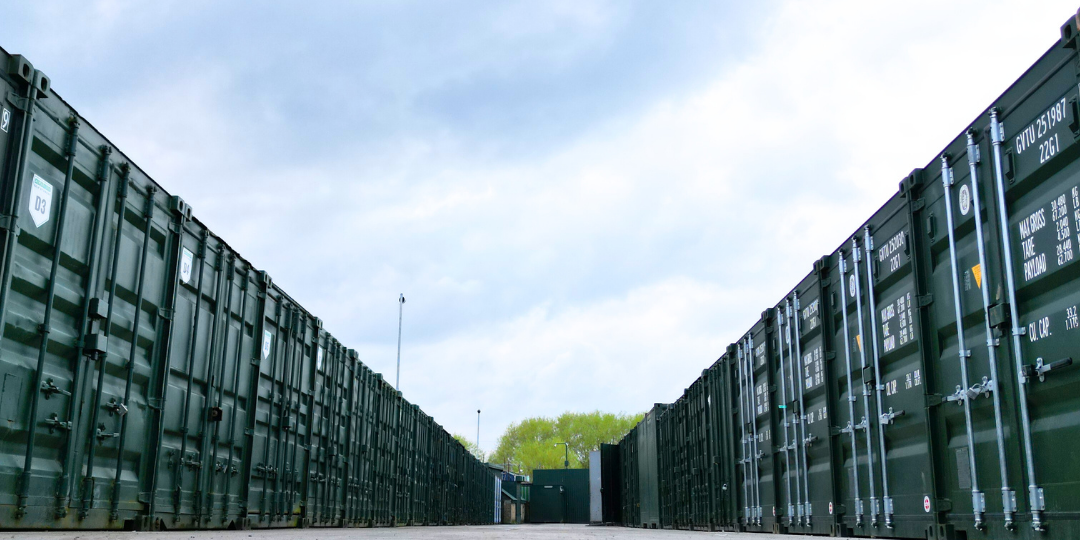
Aveley Self Storage runs container self storage rather than a traditional indoor facility, which matters for ecommerce: units sit at ground level with direct vehicle access, so pallets and heavy boxes go in and out without stairs or narrow corridors. See Amazon sellers storage and ecommerce stock storage for the full specification.
How Ecommerce Stock Storage Works at Aveley Self Storage: From Delivery to Dispatch
A working ecommerce storage unit needs three zones inside one container: goods in near the door for new stock, shelving along the back and sides for picking, and a small pack out bench near the front for taping, labelling and staging.
Stock arrives either as a supplier pallet delivered by lorry, or as smaller parcel drops from a courier. Aveley Self Storage sites take forklift and lorry access as standard, a detail most home based sellers do not appreciate until they have tried to manhandle a shrink wrapped pallet through a front door. Once inside, stock is checked against the purchase order and shelved for FBM fulfilment or repacked into Amazon inbound cartons for an FBA shipment. The unit is controlled site access with CCTV, so stock sits securely between visits without anyone needing to be on site permanently.
Amazon Seller Storage Costs: FBA Fees vs Self Storage for Ecommerce Stock
This is where the arithmetic changes seller behaviour. Amazon’s own published FBA storage fee schedule charges standard size inventory at £0.76 per cubic foot per month from January through September, then £1.51 per cubic foot from October through December. That is close to double, landing during exactly the weeks a seller most needs stock ready for Prime delivery.
Sellers who hold buffer stock outside Amazon’s fulfilment centres, then send smaller, more frequent replenishment shipments, sidestep three cost triggers at once: the Q4 storage rate, the long term storage fee applied once stock has sat 241 days or more, and the storage utilisation surcharge past roughly 22 weeks of forecast cover. A self storage unit charges one flat monthly rate, whether half empty in January or packed to the ceiling in November.
Run the numbers on a modest 500 cubic foot holding of standard size stock. Left inside Amazon’s network for October to December, that is £755 a month in storage fees alone, before a single fulfilment fee. The same 500 cubic feet sits comfortably inside a 20ft unit (roughly 1,163 cubic feet of internal volume), at a fixed monthly rate regardless of season. For a seller carrying meaningful Q4 stock, that gap often covers the unit’s cost several times over. Get exact pricing through get a quote.
FBM sellers have a simpler equation: no Amazon storage fee, but no free stockroom either. Every FBM seller needs somewhere to hold stock between sale and dispatch, and a garage rarely handles repeated pallet traffic well.
Self Storage Unit Sizes for Amazon Sellers: 5ft, 10ft, 20ft and 40ft Explained
Aveley Self Storage offers four container sizes, each mapping onto a different stage of an ecommerce business rather than a vague “small, medium, large” label.
| Unit | Floor area | Internal height | Approx. volume | Typical ecommerce use |
|---|---|---|---|---|
| 5ft | approx. 37.5 sq ft | 7ft 9in | approx. 290 cu ft | Side hustle seller, single product line, box stock only |
| 10ft | 75 sq ft | 7ft 9in | approx. 581 cu ft | Growing FBM seller, several SKUs, occasional pallet deliveries |
| 20ft | 150 sq ft | 7ft 9in | approx. 1,163 cu ft | Multi SKU seller running FBA and FBM side by side |
| 40ft | 300 sq ft | 8ft 6in | approx. 2,550 cu ft | Established seller with regular pallet turnover and a pick, pack, dispatch line |
The 5ft figure is derived from Aveley’s own published square footage for the 10ft, 20ft and 40ft units, which all scale at a consistent 7.5 sq ft of floor space per foot of length. Applying that ratio to a 5ft container gives roughly 37.5 sq ft, smaller than a single garage bay but with 7ft 9in of headroom for boxes stacked several high. Full dimensions are on the size guide.
How Many Pallets Fit in a 5ft, 10ft, 20ft or 40ft Storage Unit for Amazon Sellers?
A UK standard pallet measures 1.2m by 1m, a footprint of roughly 12.9 sq ft. Working through the floor area arithmetic, and leaving space to reach the stock rather than packing wall to wall:
- 5ft unit: 1 to 2 pallets, treated better as box storage than pallet storage.
- 10ft unit: 3 to 4 pallets with an aisle, or 5 to 6 shuffling stock to reach the back row.
- 20ft unit: 6 to 8 pallets with a working aisle, up to around 11 single stacked with a weekly reshuffle.
- 40ft unit: 12 to 16 pallets with aisle space for a hand pallet truck, up to around 24 double stacked using the extra height.
These figures are derived from floor area and the standard pallet footprint, not a guarantee. Light, small SKUs beat these numbers; bulky, low density stock falls short.
Which Storage Unit Suits Your Amazon or Ecommerce Business? A Suitability Matrix
| Situation | Recommended unit | Why | Wrong for |
|---|---|---|---|
| Side hustle, under 20 orders a week, one or two product lines | 5ft | Box stock and packaging without paying for unused space | A seller already running multiple SKUs or pallet deliveries |
| Growing FBM seller, 20 to 80 orders a week, 5 to 15 SKUs | 10ft | Shelving, a pack out bench and an occasional small pallet | A seller still testing one product with no real volume |
| FBA and FBM combined, 15 to 40 SKUs, weekly pallet deliveries | 20ft | Goods in, picking and pack out with aisle access | A one product side hustle that would rattle around |
| Established multi SKU seller, daily dispatch, regular pallets | 40ft | Highest ceiling in the range, room for a full pick, pack, dispatch line | A seller who could run comfortably from a 10ft or 20ft |
| Purely digital or dropship business with no physical stock | None | There is nothing to store | Any seller genuinely holding inventory |
Self Storage for the Side Hustle Amazon Seller (5ft Storage Unit)
The side hustle seller runs Amazon or eBay alongside a full time job, usually with one or two product lines and order volumes in the tens per week. A 5ft unit is the sensible starting point rather than jumping straight to a 10ft “just in case.” At roughly 37.5 sq ft, it holds several months of box stock, packaging and a tote of returns, without paying for space that stays mostly empty.
The real advantage over the garage is protecting a home rather than saving space: boxes stop colonising the hallway, and there is a dedicated place to pack orders rather than the kitchen table. With no lock in contract, a side hustle seller can start small and step up the moment volume justifies it. Once weekly sales become genuine income rather than a hobby, HMRC guidance on income from online platforms explains when that trading needs declaring.
Self Storage for the Growing Amazon and Ecommerce Seller (10ft and 20ft Storage Units)
Once a seller is placing regular supplier orders, running more than a handful of SKUs, or splitting stock between FBA and FBM, a 10ft or 20ft unit becomes the working stockroom rather than a spillover space, with pallets or large parcel drops arriving weekly or fortnightly.
A 10ft unit suits a seller running 5 to 15 SKUs still mostly hand carrying stock, with the occasional small pallet. A 20ft unit suits the seller who has moved to genuine pallet deliveries, wants a proper aisle for a pallet truck, and needs wall space for racking across several SKUs. Both sizes sit on the same site, so upgrading as the business grows is straightforward. Read more on the stock storage page.
Self Storage for the Established Multi SKU Amazon Seller (40ft Storage Unit)
At the top end sits the established seller running daily dispatch, holding 40 plus SKUs, or receiving regular pallet deliveries from multiple suppliers. The 40ft unit gives 300 sq ft of floor space and the tallest ceiling in the range at 8ft 6in, enough for proper pallet racking and separate goods in, picking and pack out zones.
This is also where the FBA cost arithmetic bites hardest. A seller holding 1,500 to 2,500 cubic feet of stock inside Amazon’s network across Q4 faces a storage bill running into several thousand pounds for October to December alone at the £1.51 rate. Holding that volume in a 40ft unit instead keeps the cost fixed through exactly the months it would otherwise spike.
Managing Seasonal Stock Spikes: Christmas, Black Friday and Q4 Self Storage for Amazon Sellers
Every seller with any seasonality knows the pattern: stock builds through September and October, peaks around Black Friday and Cyber Monday, and holds heavy right through to Christmas dispatch cut off dates. That is precisely when Amazon’s storage fees roughly double, pushing many sellers toward holding pre season stock externally and feeding Amazon only what current sales velocity needs.
A container unit rented flexibly handles this well because you are not locked into a size that suits January’s quiet trading. A grower who normally runs a 10ft unit can step up to a 20ft for the September to December build up, then step back down once the new year clears the shelves, with no penalty from a fixed term lease. Sellers stocking bulky seasonal lines, garden furniture in spring, decorations in autumn, toys before Christmas, find the taller 40ft unit useful, since its extra 9 inches of headroom adds real stacking capacity when volume is highest.
The mistake to avoid is leaving sizing until the stock has arrived. Ordering Q4 inventory in July, then finding space for it in November, is how sellers end up with pallets stacked in a garden because summer’s unit no longer fits what turned up.
Pick, Pack and Dispatch Workflow in a Self Storage Unit for Ecommerce
A storage unit only works as a dispatch base if it is laid out like one, not used as a box pile. The workflow that holds up under real order volume: incoming stock checked against the purchase order and shelved by SKU, fastest movers nearest the door. Orders are picked against a daily list, boxed at a dedicated pack out area, then staged by the door ready for collection.
Labelling matters more than first time sellers expect. A unit with 20 or more SKUs and no shelf labelling turns a two minute pick into a ten minute hunt. Sellers running both FBA and FBM from the same unit benefit from a separate area for Amazon bound cartons, since mixing the two is a common mistake to unpick with Amazon support.
Because Aveley Self Storage units allow lorry and forklift access, a courier collecting a full day’s dispatch does not disrupt the rest of the operation the way manoeuvring a van down a residential street would.
Where to Handle Returns: Ecommerce Stock Storage and Reverse Logistics in Thurrock
Returns are the part of ecommerce operations almost nobody plans space for until it becomes a problem. Every FBM seller, and any FBA seller handling their own returns rather than using Amazon’s grading service, needs somewhere to receive, inspect and decide the fate of returned stock: back to sellable inventory, a discounted listing, or write off.
A dedicated returns shelf or crate, kept apart from fresh saleable stock, avoids the single most common small seller mistake: a returned item going back out to a new customer unchecked. For a seller running a 10ft or 20ft unit, allocating one shelf bay to returns pays for itself the first time it stops a damaged item shipping twice. Established sellers in a 40ft unit often ring fence a genuine returns corner, kept distinct from goods in and dispatch.
Access and Location: Why Same Day Access Matters for Amazon Sellers in Thurrock
Dispatch deadlines do not move for anyone. A seller who cannot reach their stock the day a large order lands, or the day before a courier cut off, loses the sale regardless of how well the rest of the operation runs.
Aveley Self Storage sits at Bretts Farm, Romford Road, South Ockendon, within easy reach of Aveley, Grays, Purfleet, West Thurrock, Chafford Hundred, Lakeside, Rainham, Upminster, Ockendon and Orsett. For a seller doing an evening pack out run after work, or a Saturday restock, the unit becomes part of the working week rather than an occasional trip. Controlled site access and CCTV cover mean stock is secure between visits without staff needing to be present around the clock. For couriers and pallet deliveries, that same access removes the biggest friction point in ecommerce fulfilment from a home base: getting heavy stock in and out without blocking a residential road. Full coverage details are on the our coverage page.
Self Storage vs Renting a Warehouse for Ecommerce Stock Storage
A small commercial warehouse looks like the obvious next step once a seller outgrows home storage, but the commitment rarely matches where an ecommerce business sits at that stage. Warehouse leases typically run three to five years, carry a service charge on top of rent, and usually make the tenant liable for business rates separately from the rent, based on the Valuation Office Agency’s rateable value for the property. Dilapidations, the cost of returning the space to its original condition at lease end, is another bill first time tenants rarely budget for.
Self storage carries none of that structure. There is no lease to negotiate, no dilapidations clause, and no rates bill separate from the unit cost, since the provider carries that liability rather than passing it to individual tenants. For a seller who genuinely needs warehouse scale racking and a permanent staffed goods in desk, a warehouse eventually becomes the right call. Below that scale, a 20ft or 40ft container gives comparable floor area without the multi year commitment. The warehouse storage page covers the alternative in more detail.
Self Storage vs a Serviced Office With a Stockroom for Amazon Sellers
Some sellers, running a wider business alongside ecommerce, consider a serviced office with a small stockroom instead of storage. A serviced office is priced per desk, built for meetings and admin, not repeated pallet deliveries or a pack out bench covered in tape. Most restrict trolley or forklift access, and many have lift only access to upper floors, turning a pallet delivery into a genuine problem.
A serviced office suits a seller who needs a meeting space or a registered address alongside light stock holding, small parcels only, no pallets. For anyone whose stock volume justifies a proper pick, pack, dispatch flow, a container unit with direct vehicle access outperforms an office stockroom.
Who Ecommerce Stock Storage in Thurrock Isn’t For
Self storage genuinely is not the right answer for every ecommerce business, and it is worth being direct about that rather than pretending one size fits all.
If your entire model runs through Fulfilment by Amazon with no stock ever held outside Amazon’s own centres, and you are not chasing the Q4 fee arithmetic covered earlier, you may not need external storage. If your operation needs a staffed goods in desk, warehouse management software and multiple loading bays, that is warehouse or 3PL territory, not container self storage. And if your business is a handful of sales a month with a shoebox of stock, a garage shelf will do for now.
Container self storage suits the middle ground: real, growing stock volume, not yet ready for a commercial lease, and not wanting to be tied to one.
Mistakes Amazon Sellers Make When Choosing Self Storage for Ecommerce Stock
Sizing for today’s stock, not the next six months. A seller who books a 5ft unit based on current SKU count often needs a bigger unit within a season, especially heading into Q4.
No dedicated pack out space. Treating the unit as a box pile, with no bench or clear area to pack orders, slows every dispatch and makes damage more likely.
Mixing FBA bound and FBM stock with no separation. Without a clear physical line, mis picks happen, and untangling a wrongly shipped FBA carton with Amazon support eats hours a seller does not have.
Ignoring returns space entirely. A returns pile left in the picking area is how damaged stock ends up back on the shelf as sellable, both a customer complaint and a chargeback waiting to happen.
Self Storage for Amazon Sellers: Common Objections Answered
“Isn’t a storage unit just for furniture and house clearance stock?” Container self storage handles business stock just as well as household items. The same forklift and lorry access that helps a house move helps a pallet delivery.
“Will my stock actually be secure?” Aveley Self Storage runs controlled site access, CCTV coverage and manned security, the same setup that has earned 5 star Google reviews. Stock is considerably more protected than a garage at a residential address.
“Isn’t this more expensive than just using my garage?” In cash terms, a garage is cheaper because it is free. What it costs is time, space in your own home, and a ceiling on how much stock you can hold before the business is constrained by where you live.
Real Scenarios: Self Storage for Amazon and Ecommerce Sellers in Thurrock, Grays and South Ockendon
The evenings and weekends seller in Grays. Runs a single homeware line on Amazon and eBay around a full time job, around 15 orders a week. A 5ft unit holds three months of stock plus packaging, and a Tuesday and Saturday visit keeps dispatch on schedule.
The growing FBM seller in South Ockendon. Twelve SKUs across kitchenware and pet accessories, a part pallet delivery every fortnight. Moved from a 10ft to a 20ft unit after a strong autumn, gaining room for proper shelving.
The Black Friday spike in Purfleet. A seasonal decor seller who normally runs a 10ft unit steps up to a 20ft from September through December to hold pre built Q4 stock, avoiding Amazon’s October to December rate on the bulk of it.
The established multi SKU seller in Chafford Hundred. Forty plus SKUs across two Amazon accounts and a Shopify store, daily dispatch, weekly pallets from three suppliers. Runs a 40ft unit with racking, a returns corner and a pack out zone.
Amazon Seller Storage Myths: What Sellers Get Wrong About Self Storage
“Self storage is only for people moving house.” Much of container self storage demand in Thurrock now comes from business use, and Amazon and ecommerce sellers are one of the fastest growing groups within that, tracking the same growth in online retail that ONS data shows nationally.
“You need a warehouse lease to look like a proper business.” Plenty of established sellers with six figure annual turnover run entirely from a self storage unit. What matters to Amazon, customers and couriers is that orders ship correctly and on time.
“Storage units aren’t secure enough for valuable stock.” A well run container site with CCTV, fencing and controlled access is considerably more secure than stock held at a residential address.
Is Self Storage Right for Your Amazon or Ecommerce Business? Our Verdict
For a seller carrying real, growing stock volume who is not yet ready for a commercial lease, container self storage is the sensible middle step. The FBA fee arithmetic alone, especially through Q4, makes a case for holding buffer stock externally that most sellers never actually run the numbers on. Our view: size one step ahead of current volume, treat the unit as a working stockroom with proper pick, pack and dispatch zones rather than a box pile, and use the no lock in flexibility to flex up for peak season rather than renting for the busiest month all year round. For a business genuinely at warehouse scale, a commercial lease eventually makes sense. Below that point, a 5ft to 40ft container covers most Amazon and ecommerce sellers in Thurrock comfortably.
Self Storage for Amazon Sellers FAQ
Q1 Can I run my Amazon FBM business entirely from a storage unit?
Yes. A container unit with vehicle access works well as a stockroom and dispatch base, covering goods in, picking, packing and staging orders.
Q2 What size storage unit do I need for 10 to 20 SKUs?
Most sellers at that SKU count are comfortable in a 10ft or 20ft unit, depending on order volume and how often pallet deliveries arrive.
Q3 Does Amazon charge extra to store inventory over Christmas?
Yes. Amazon’s standard size FBA storage fee rises from £0.76 to £1.51 per cubic foot per month between October and December. Holding buffer stock outside Amazon’s network avoids paying that rate on your full inventory.
Q4 Can couriers collect directly from a self storage unit?
Yes, provided the unit has proper vehicle access. Aveley Self Storage sites take lorry and forklift access as standard.
Q5 Is a storage unit secure enough for high value stock?
A well managed container site with controlled site access, CCTV and manned security offers a genuinely secure environment, reflected in Aveley Self Storage’s 5 star Google reviews.
Q6 How quickly can I scale up from a smaller unit to a bigger one?
With no lock in contract, moving from a 5ft to a 10ft, or a 10ft to a 20ft or 40ft, is a matter of arranging the new unit rather than renegotiating a lease.
Q7 Do I need to pay business rates if I store ecommerce stock in a storage unit?
No, not in the way a commercial warehouse tenant would. Under current Valuation Office Agency guidance, self storage sites are assessed as a single hereditament, with the provider responsible for that liability.
Q8 Is self storage better than storing stock at home for a growing Amazon business?
Home storage can work for a small side hustle for a while. Once order volume or seasonal stock builds spill into living space, a dedicated unit almost always pays for itself in time saved and stock protected.